

When a tournament comes to an end the natural reaction of all the participants will be to look forward. Any team that suffered the indignity of a group stage exit will be quick to turn the page. The winners and anyone else satisfied with their performance look forward to the next challenge.
Luckily for Palestine, they fall in with the latter. The 2025 FIFA Arab Cup was a huge success that took them to the brink of the tournament’s semifinals. It was perhaps the furthest the team could have gone given the circumstances.
Less than impressive in the buildup
Before the tournament started there was very little evidence to suggest Paletine was capable of reaching new heights at the Arab Cup. The team rallied in World Cup qualification to beat Iraq 2-1 in the dying embers of the match back in March. In June, the team traveled to Kuwait and won 2-0 to set up a win-and-in scenario against Oman on neutral ground in Amman.
Palestine did find a goal early in the second half and if not for a controversial penalty kick decision would have advanced to Round 4 in World Cup qualification. Mooud Bonyadifard’s botched call papered over some of the errors in dealing with the match.
Palestine had a man advantage since the 73rd minute, yet finished with a meager 42% possession. The team did not take the chances that fell to them and the coaching staff did not make the appropriate adjustments to gain a foothold and see the match out.
Palestine’s September friendly against Malaysia was a disaster with the team being pulled apart defensively by a side three dozen spots below them in the ranking.
October brought a doubleheader against Algeria’s A' team and while the team saved face by winning the second match 1-0 the first match ended in a commanding 3-0 victory for the hosts.
A friendly tour of the Iberian peninsula netted a 3-0 loss against Euskadi and a 2-1 reverse against Catalunya. While the results were of secondary importance the manner of which they came raised serious alarm. Three out of the five goals came on set pieces.
While outsiders might had doubts, Ehab Abu Jazar was adamant that the team could not only qualify for the FIFA Arab Cup- it could make a run.
“My wife asked me why I was packing so many clothes before I left for Spain. I said I was going to be gone for 40 days.” The 45 year old manager told Football Palestine.
He was off by a week.
Digging Deep
The Arab Cup play-in match against Libya was the team’s inflection point. There was a desire amongst the collective group to put the horrors of the Oman game to bed. To end the year on a high and to start building momentum ahead of the 2027 Asian Cup.
The problem for Palestine was the fact that many of their key players would be playing matches for their clubs 48-72 hours before taking to the pitch at Al-Gharafa Stadium.
The list of players who battled match and travel fatigue were: Musab Al-Battat, Mohammed Saleh, Michel Termanini, Tamer Seyam, Hamed Hemdan, Moustafa Zeidan and Oday Dabbagh.
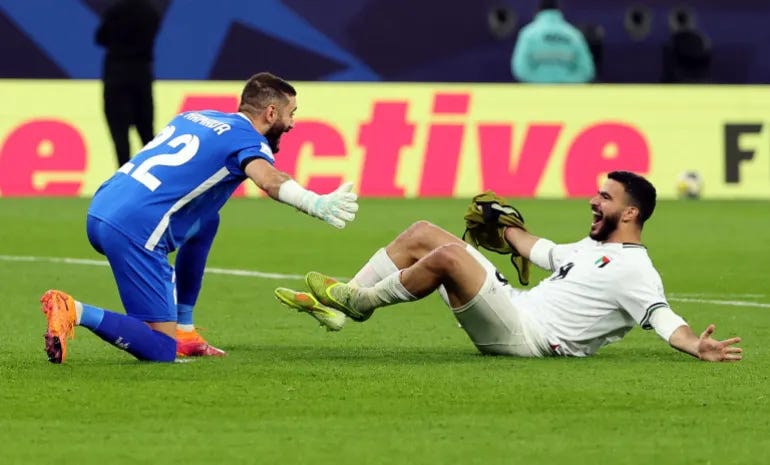
The players pushed through and even though Palestine waned in the second half they did enough to win the match. Only a heroic defensive stand from Libya kept Palestine at bay. The penalty kick shootout might have frayed the nerves of Palestine supporters but the players themselves relished the moment.
Oday Dabbagh went top bins and Rami Hamadi made a save to give Palestine an early advantage. Their confidence gave the rest of the team a lift. Hemdan blasted home. Mohammed Saleh went top bins and paid homage to Ronaldo with a premature celebration. Even after Michel Termanini’s attempt was saved there was no doubt. Amid Mahajna’s penalty kick was perfect and Libya missed their fifth attempt to send Palestine to the tournament finals.
Any doubts about the team’s mentality following the heartbreak in Amman were put to rest.
More than the mental side of the game there was a physical strength that helped them navigate a path to the tournament finals.
There was no shortage of drama back in September when it was revealed that Ehab Abu Jazar and Mohammed Dajani had acrimoniously split following the loss to Oman.
Dajani’s dismissal from the coaching staff left many fans upset and questioning the direction of the team. A Palestinian coach with European experience and the requisite badges was being jettisoned with no obvious replacement.
Dajani described his six months as part of the national team staff as “the most unprofessional environment I have ever worked in”
In Abu Jazar’s defence, the fact that he could not select his own assistants increased the possibility of friction.
To replace Dajani, Abu Jazar went on the hunt for a physical preparatory coach and started to ask contacts in Egypt if they knew of a suitable contact. Taha Noah’s name came up and following a brief phone call he agreed to join the staff for the Arab Cup provided Al-Ahly agreed.
Noah was not the main physical preparatory coach at the Cairo giants but his expertise working with some of the best in the business was put to good use with Palestine.
One player told Football Palestine about the Egyptian’s techniques in training:
“He worked us hard. We would run like crazy even between matches he would insist that it was an important part of recovery. Some complained but you could see the results on the pitch.”
Palestine not only managed to survive the Libya game they also scored late goals against Qatar and Tunisia and mounted a comeback against Saudi Arabia that fell just short.
The physical base Palestine had developed helped them translate their mental fortitude to physical expenditure.
“During the Tunisia game the GPS readers were going berserk- Taha even tried to get us to manage our energy more wisely.” the same player told Football Palestine
In an interview with On Sports the Noah spoke highly of the mentality of the Palestinian player “These players play football in conditions that would break other players. They deal with mental challenges that would render other players unable to play.”
That fortitude and fitness also came into play in the last group game against Syria.
Ehab Abu Jazar termed it “the most difficult match of the tournament” which comes as some surprise given how many observers claimed that the two teams had agreed to play out a draw.
“The plan was to press them high up and nick a goal early on so we could relax a little bit.” Abu Jazar said.
“When we went into the dressing room and saw that Tunisia was up 2-0 our entire approach and instructions to the players changed.”
Abu Jazar wanted to make sure that in a worst case scenario the team would not concede and a more defensive posture was taken up.
“We learned from what happened to us against Oman we were not going to give up what we had.” Abu Jazar elaborated.
For their part, Syria were not keen to come forward even though they had a head-to-head tiebreaker against Tunisia and could afford to lose the match against Palestine.
Palestine saw out the match but held on to their substitutions until late in the game. Wary that they might need to switch to an attacking posture at any minute.
Bold Selections Choices
This Arab Cup campaign featured no shortage of surprises. The biggest of which came in the form of a player who was not even part of the squad for friendlies against Malaysia, Algeria, Euskadi, and Catalunya. Not only was Mohammed Saleh included in the Arab Cup squad but he started every single game for the team.
Saleh’s return coincided with him playing his best football in years and becoming a regular starter for Al-Rayyan. The gamble to bring him back following his horror show vs. Jordan paid immediate dividends. The 32 year old scored his penalty kick against Libya and then followed that up by getting a crucial touch on the ball for the winner against Qatar.
At 32, there is very little hope for the Gazan defender to contribute in any meaningful manner for the 2030/31 qualification cycles. Int he short term, with a shallow list of choices at centreback, he proved to be one of the better options.
The choice to call him back was a bold one but he slotted into his position with ease. In fact, it was Saleh who was barking orders about positioning during the Libya match. In retrospect, the time away from the national team did both parties a world of good. Saleh found form and fitness with his club and came back to the national team unburdened.
Is he the best centreback Palestine has ever produced? Not by a long shot- but he is one of the best Palestine has at its disposal now.
There was also a tremendous amount of faith placed in the likes of Ameed Sawafta, Ahmad Al-Qaq, Khaled Al-Nabris, and Emilio Saba. The total amount of caps this group had collected was five all by Ameed Sawafta. Total starts? ZERO.
The quartet all started games in December for Palestine and all repaid the faith that Ehab Abu Jazar had placed in them in spite of their relative youth and inexperience.
For all that worked well there was one gambit that did blow up in the coaching staff’s face. The team played the tournament with only 22 players because of Badr Moussa’s injury. An attempt to swap Moussa with Mohammed Balah failed at the eleventh hour. The reason for its failure is the subject of much debate; whatever the reason it meant Palestine were shorthanded for the remainder of the tournament.
Even when Moussa recovered from his injury in time to play in the tournament proper he was subject of a tug of war between Petrojet and the National Team. One that Palestine lost.
Reasons for Palestine’s Elimination
There is not a single reason as to why Palestine’s run at the FIFA Arab Cup came to an end in the quarterfinals. One of the things that were achieved at the tournament was the ability to compete in spite of a slew of injuries and absences.
“I was ready to go to war with my team. I did not feel that we needed someone else in the squad they did what we asked them to.” Ehab Abu Jazar told Football Palestine.
While that might be the case, it was clear that this team lacked the type of depth other squads came to Qatar with. In particular there was a certain type of player that was missing: An attacking player with speed who could hurt teams on the counter or to give the attack a spark in the last embers of the game.
Saudi Arabia were vulnerable- in a game that was decided by the slimmest of margins- but Palestine could not stretch them in transition. The fact of the matter is that there are few players in the pool that can do that job. Adam Kaied and Mohamed Hebous would have been the obvious choices, along with Badr Moussa. Having the likes of Wessam Abou Ali or Assad Al-Hamlawi would have also helped.
With the game on the line and injury and fatigue setting in you got the sense that Palestine could only see Saudi Arabia off via penalty kick shootout. The team fell four minutes short of that in a controversial passage of play that Saudi Arabia used to its full advantage.
What Comes Next
In an interview with Palestine TV Ehab Abu Jazar promised fans that the best was yet to come and that the team was poised to do even more at the 2027 AFC Asian Cup.
There are reasons to share in the manager’s optimism but perhaps the most difficult challenge ahead will be to quickly forget about the 2025 FIFA Arab Cup. The team cannot rest on its laurels and the upcoming Asian Cup could throw Palestine into a group every bit as difficult as the one they just navigated successfully (aside: imagine being drawn with Japan, Jordan, and Indonesia).
The side will also only have the March, June, September/October, and November windows to stage friendlies before heading to Saudi Arabia to contest the continental showpiece. In that time, the players that weren’t part of the Arab Cup campaign need to be blended with the core of the squad and new players need to be recruited and given chances.
From a personnel point of view- Palestine has to find more centrebacks and hope that Khalid Abu El Haija can continue to develop with Nuremberg. The towering defender started eight out of the nine last matches for the reserve side before joining the national team, leading the side to first place in the German fourth tier.
Wingers and play makers are also another area in need of more tinkering, recruiting and experimentation. The fact that the league in the West Bank shows no signs of returning only complicates matters.
Palestine are now in uncharted territory- the national team experienced a cultural breakthrough and optimism instead of cynicism reigns amongst its fan base. The question is whether those in charge will be able to build on their unexpected success.