

View from the Periphery on Infantino's plans and his future
Football needs unity and solidarity but Europe tends to forget about the periphery until it needs our help.
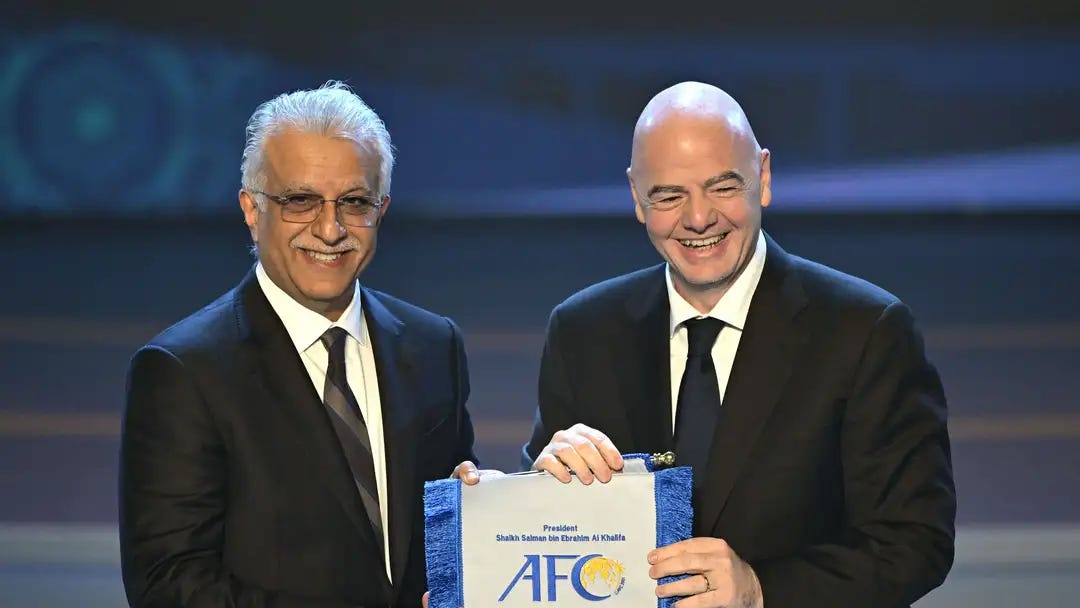
For the past decade, FIFA President Gianni Infantino has done what he wanted at the helm of the beautiful game. Once nothing more than a pencil pushing legal director for UEFA he now sees himself part celebrity and part king.
FIFA now does crypto vis-a-vis its fan tokens, it also does prediction markets (a fancy way of saying gambling) and dynamic ticket pricing. It has been allowed to do all this to the detriment of the average fan. One of the hallmarks of past World Cups was ensuring the visa-free travel of all ticket holders. This meant that even Israelis could enter Qatar and attend the World Cup in 2022. In 2026, FIFA could not even secure entry for its own referee. Let’s not even get started on how Iran was treated by the host country.
It seemed to those of us on the outside that the direction of FIFA and world football had already been set. Martyn Ziegler’s bombshell report in The Times was sensational but far from shocking. The only shock is that the plan has been shelved.
Infantino marketed the plan as a way to give each member association (MA) $40 million instead of a paltry $10 million per cycle. According to the FIFA President, these funds would have been used to develop football and to create a dozen more stories like Curaçao and Cape Verde.
In reality, spinning off FIFA’s competitions into a commercial entity called the FIFA Forward Enterprise (FFE) and selling a 21% stake for $4.2 billion probably had more to do with Infantino’s desire to stay in power beyond 2031 and to take the role of FFE Commissioner with a salary 10x the $3 million per annum he currently receives as a base salary.
In layman’s terms the plan was akin to a homeowner with a fully paid off mortgage and plenty of cash in the bank taking on roommates to earn more money.
FIFA does not need to raise funds because it has billions of dollars in its reserves. Outside capital would come with extra obligations just as a homeowner would need to respect the rights of tenants living under his roof.
In the end, UEFA’s threat of boycott and a unanimous 55-0 vote against the plan meant it was dead on arrival. The AFC and Concacaf issued statements that were not as strong but decried the lack of transparency and due process.
The reprieve is welcome news for fans of the beautiful game but it seems that no one in Europe has bothered to ask why Infantino felt so confident in his ability to force this plan through.
How Football is run in the periphery
Part of football’s appeal is its universality. It is the number one sport in 155 of the 211 FIFA member states. There is talent in every corner of the globe but there are not the same resources. FIFA’s solidarity payments are supposed to help with development but the problem is often not finances but personnel.
Many MAs are run by people with very little interest in the sport or its development. FIFA might have introduced term limits but those do not apply for individual MAs. In Palestine, Jibril Rajoub won his first election as Palestine Football Association (PFA) President in 2008 when Jihad Talmiyeh dropped out in the eleventh hour. He won unopposed and won reelection in 2013, 2018, and 2023 in the same fashion.
The PFA is one of hundreds of MAs around the world that does not release any audited financials of its spending. FIFA only asks for audited accounts of funds allocated to construction projects. As a result, we have no idea what the PFA has been spending money on given the fact that it has not funded the domestic league over the past three years.
Infantino lets this situation go on unabated. So did his predecessor. It is very likely whomever succeeds him will also maintain the status quo.
Some of FIFA’s money has been spent on football related projects. The most prominent youth academy in the country carries the name of Sepp Blatter. It was built as part of the Goal Program (the forerunner to FIFA Forward). The construction of the national stadium in Jerusalem and subsequent refurbishments were also built with FIFA’s help.
Besides that, it is hard to understand where the money goes. In the aftermath of a 4-0 drubbing at the hands of Morocco in 2021 the Quds Network revealed that the amount of money spent on sport in the State of Palestine amounted to more than 46 million shekels ($15 million) in the first ten months of 2021. Palestine have never won a medal at the Olympics and almost all their sporting success has come in football.
The amount of people employed by the Higher Council for Youth and Sport was also staggering: Those with a General Manager title amounted to 25 employees, “A” Managers were 59 in total, “B” Managers made up 20 employees, and a further 54 employees had the title of “C" Manager.
Meanwhile in September 2024, the national team had to go on strike and refuse to train for 24 hours to receive a bonus of $5,000 per player after they had brought in more than $3.5 million in prize money with their success at the 2023 Asian Cup and 2026 FIFA World Cup qualification.
The 158 people in Jibril Rajoub fiefdom living off of funds given to Palestine from the IOC, FIFA, and other international benefactors are largely tethered to a desk. Giving Rajoub 4x the funds would be met with joy and acceptance. Most of those funds will do nothing to develop football in Palestine but why would Infantino really care about that?
This is the same man, after all, that has FIFA paying for his apartments in Paris and Switzerland and the school fees for one of his daughters in Miami.
For Rajoub, if everyone is pulling in the same direction- saying private equity funding is good. Why should he stand in the way? He has never thought about the good of the game in Palestine. So why would he think about the good of the game on a global level?
Palestine has achieved enough success on the backs of its selfless players for FIFA to hold it up as an example and for the PFA to take the credit. There are many MAs on the periphery that do far worse with even more resources.
It is also worth pointing out that some small MAs do allocate funds properly. Cape Verde made the World Cup with just seven full time employees working for its football association.
Can Infantino turn it around?
With the speed at which things are preceding its highly likely that Infantino will at least face a vote of no-confidence sometime in the coming days.
The Swiss lawyer had previously collected 200 declarations of support for his reelection. In spite of term limits prohibiting more than three tenures of four years, Infantino reasoned that his first term in office did not count as it was only three years.
March’s election could be a contested race. One that might not even feature the incumbent.
That said, Infantino still has rock solid support in South America and Africa- a block of 65 votes. The secret ballot is supposed to stamp out the mafia-like pledges of allegiance but it has instead disincentivized opposition candidates from running.
In spite of FFE being rejected by the three largest confederations there have been messages of support. Namely from Qatar and Morocco who said they still support Infantino’s leadership in the aftermath of UEFA's declaration of no confidence.
Infantino has worked his way into the good graces of both federations after starting off on the wrong foot. Qatar did not back Infantino in 2016 but did its upmost to support him. It was a wise move for Qatar, who a year after Infantino’s election, found themselves blockaded by their neighbors. That blockade included Bahrain who has one of its royals- Sheikh Salman- running the AFC.
Infantino took up residence in Doha ahead of the World Cup. His daughters attended elite private schools in the country and a FIFA sponsorship with Qatar Airways netted him a private jet.
In return, the World Cup was not taken off Qatar- which had become a demand of the blockading countries and had started to receive support in Western media outlets. Qatar also benefited from this relationship- becoming the new home of the FIFA Arab Cup through 2033 and the U17 World Cup through 2029.
Morocco’s relationship with Infantino also got off to a rocky start after their 2026 bid book was deemed to be ‘high risk’ while the United bid got a ‘low risk’ rating. The Moroccans, after five failed bids, finally won the right to co-host the World Cup in 2030. Infantino and FIFA got a regional office in Rabat shortly after Morocco was confirmed co-host by acclimation in December 2024.
These are just two examples of how FIFA works. This is how it always has worked. UEFA knows this because it has played a part in this system of patronage.
Germany won the right to host the 2006 FIFA World Cup by using a slush fund of 6.7 million Euros to bribe four Asian members of the executive committee to vote for their bid over that of South Africa.
Having learned how to play the game South Africa and Morocco offered up bribes to ExCo members for the 2010 hosting rights. The bid process for 2018 and 2022 was also blighted by the same behavior- on the part of both the winning and losing bids.
MAs that have spent nearly a decade currying favor with Infantino will not risk losing that relationship. If Infantino’s demise proves to be fait accompli then that will lead to a reassessment. UEFA and CONCACAF need help from Asia to remove Infantino, either in a vote of no-confidence or at the next election slated for March 2027.
UEFA’s preferred candidate- PSG President Nasser Al-Khelaifi- has been reticent to throw his hat in the ring, not because of Qatar’s relationship with Infantino, but because of the looming presence of Sheikh Salman.
For all its perceived power Qatar has been unable to unseat Sheikh Salman as President of the AFC. Even if Al-Khelaifi were to find ten votes to tack onto UEFA and Concacaf’s blocs Qatar would still have to deal with a spurned Salman in the AFC. Salman is up for reelection in 2027, but with no term limits, he could stay on as President for another decade.
If Infantino is to fall it will be Salman who is most likely to replace him, he netted 88 votes in the 2016 election and has been patiently waiting his turn in the role of FIFA Vice President. His opposition to FFE was, in all likelihood, more about not wanting to become President of a weakened FIFA subservient to FFE and its backers in private equity.
Infantino can still stay in power and it seems his ploy is to expand the World Cup to 64 teams in order to win support to add to his base in CONMEBOL and CAF.
There is very little goodwill towards Infantino but replacing him with Salman would do little fix the underlying structural problems within FIFA. Infantino has become a symbol of brazen greed but Salman comes with his own baggage. As the chief figure for sports in Bahrain Sheikh Salman headed a committee that investigated "breaches by individuals associated with the sports movement during the recent unfortunate events in the Kingdom of Bahrain"
On the basis of those findings several athletes and footballers were arrested and tortured. One former national team player, Hakeem Al-Araibi, sought asylum in Australia and has alleged on more than one occasion that Sheikh Salman knew about the torture.
To fix FIFA and promote good governance there needs to a concerted effort to address the litany of problems that exist in the periphery. FIFA suspends federations for “government interference” but has never wielded punishments for financial irregularities, or antidemocratic behavior, or for infringing on the rights of players and clubs.
Until the power of the FIFA Presidency is used to address these problems the system will keep producing different types of monsters.