

What happened to this week's UEFA vote to suspend Israel?
Israeli reports proved to be inaccurate but a football ban might just be a matter of time for the Apartheid state.
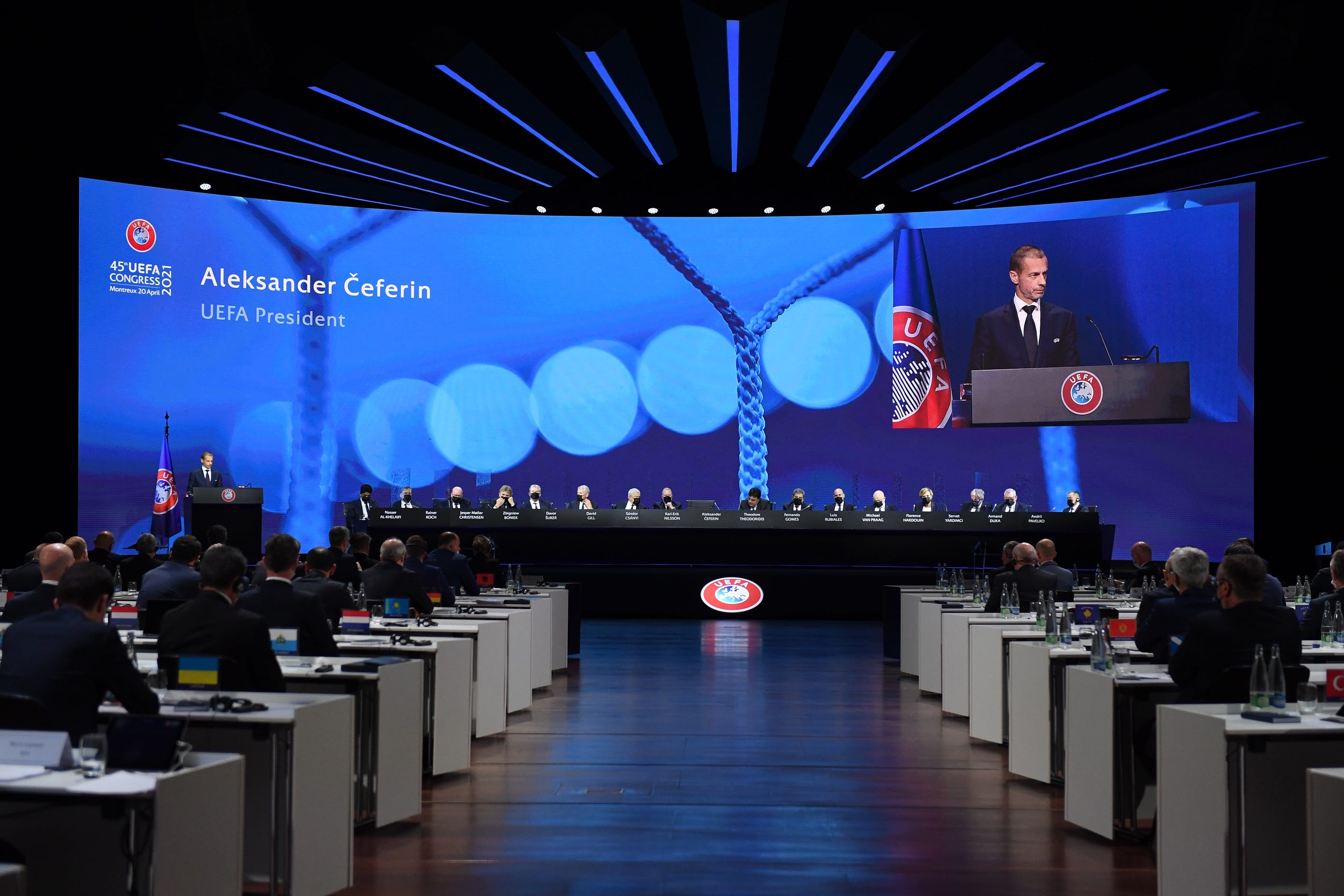
On Friday, Israel Hayom and Israel Channel 12 both reported that Israel’s suspension from UEFA was imminent. Sources within the Israel Football Association (IFA) confirmed that if the matter were to be put to a vote they simply would not have the numbers amongst the 19 members of the UEFA Executive Committee to stave off suspension.
“We are a step away from being in Russia’s situation” one IFA official told the Israeli press. UEFA’s position on Israel’s two year assault on Palestinians in Gaza and the West Bank elicited little rebuke. In early 2024, UEFA secretary-general Theodore Theodoridis had argued that Israel’s situation was different from that of Russia: “There are two completely different situations between the two countries. Don’t forget the start of the war in Russia and Ukraine and the start of what is happening now – which is regrettable, of course – in the Middle East.” The Greek administrator would go on to state that UEFA was not considering a suspension.
Incidents of violence committed by fans of Israeli clubs in Athens and Amsterdam in 2024 put UEFA and host cities in more of a bind. Racist language and violence were becoming part and parcel of any Israeli team participation necessitating additional security expenditure. In a partial victory for the BDS (Boycott Divestment and Sanctions) campaign, all Belgian municipalities refused to host a 2024 UEFA Nations League match between Belgium and Israel- forcing the match to be played on neutral territory.
The sustained pressure from advocacy groups and Israeli fans’ unsportsmanlike behavior has kept calls for Israel’s suspension front and center. UEFA levied fines against the fans of Celtic FC and Paris Saint Germain for political messaging over the last two seasons for tifos expressing support for the Palestinian cause and for calling for the suspension of Israel from footballing competitions.
The killing of Suleiman Obeid- who had two dozen international appearances for Palestine- in August signalled a sea change. UEFA sent a cryptic message of condolences on its social media accounts.
In response, Liverpool and Egypt star asked: “Can you tell us how he died, where, and why?” The post went viral on X generating 120 million views and nearly 2 million interactions. The following week, UEFA unfurled a banner with the words Stop Killing Children, Stop Killing Civilians before the UEFA SuperCup between Tottenham Hotspur and Paris Saint Germain. Children from various conflict zones- including Gaza- were present as mascots at the game. In spite of the neutral tone, Israelis felt targeted with the Campaign against Antisemitism stating that the “selective outrage tells us everything about the double standard that still poisons European discourse on Jews.”
Pressure continued to mount with UEFA President Aleksander Ceferin telling Politico earlier this month that “what’s happening with civilians there [in Gaza] is personally hurting, killing me.” He stopped short of supporting Israel’s suspension stating that the Russia ban had done nothing to end the war and expressing sympathy with athletes who he claimed were powerless to stop their governments from going to war.
The supposed vote was set for this past Tuesday but that deadline has passed with no further clarification from Europe’s governing body of the sport. This week also saw a slew of Western countries break with Israel and recognize a Palestinian state. These nations include the United Kingdom, France, Australia, and Canada. Also this week the United Nations urged UEFA and FIFA to ban Israel from the sport citing its expert panel which stated:
“The conclusion of the United Nations Commission of Inquiry on the Occupied Palestinian Territory, including East Jerusalem and Israel, that Israel is committing genocide is the latest in a growing number of international bodies affirming that genocide is being committed in the Occupied Palestinian Territory. The ICJ’s Interim Order of 26 January 2024 reminded every country of its legal obligations to act against genocide,” the experts said.
The obligations to prevent, not to commit or incite, and to punish genocide are universally recognised as peremptory norms of international law that apply to all, at all times, without exception, they noted.
“Sports must reject the perception that it is business as usual,” they said. “Sporting bodies must not turn a blind eye to grave human rights violations, especially when their platforms are used to normalise injustices.”
Israel had exercised significant diplomatic power to prevent its ouster from cultural and sporting bodies over the past two years. The European Broadcasting Union which organizes the musical contest Eurovision resisted calls to ban Israel in spite of a standing ban on Russian participation since the 2022 invasion of Ukraine. After two years, which also featured a massive paid operation to garner votes for the Israeli entrant, several countries have stated they will not participate in Eurovision should Israel remain in the competition.
Spain, Slovenia, Ireland and the Netherlands have all threatened to boycott prompting the EBU to push its entry deadline back from October to December in the hopes that a solution to the crisis could be found.
People power took center stage during the Vuelta de España cycling race in September with massive demonstrations against the participation of the Israel-Premier Tech team. Protestors blocked roads, waved banners and flags, and ultimately forced the race to be cut short. The protestors gained an unlikely ally in Pedro Sanchéz- the country’s Prime Minister- who commended their actions and called for the sporting and cultural boycotts of Russia and Israel.
Public pressure was further ratcheted up this week when Italy held a massive public strike in protest of Israel’s actions. Those strikes have led to the closure of ports to ships headed to Israel. Italy’s far right government caved to public pressure and sent a naval vessel to accompany the Global Sumud Flotilla which has been the target of Israeli drone attacks in the Mediterranean. Spain has since announced it will also be sending vessels to assist the flotilla.
UEFA seems to be ready to bow to the same public pressure that governments across the continent have. That said, reporting from Israel has been deliberately distorted. Football Palestine has learned from various sources that the leak served two purposes. On the domestic front, it is a projection of strength to a public who feels the pain of ostracization. Internationally, the aim was to discredit the grassroots nature of the campaign by creating a false link with Qatari lobbying.
Theoretically speaking, Executive Committee member PSG President Nasser Al-Khelaïfi could bring the matter of Israel’s suspension to a vote at the next meeting. He could have done that at any UEFA Executive Committee meeting over the past two years. The threshold to pass the ban is low; a simple majority with at least 11/19 members present would be enough to carry the motion.
Al-Khelaïfi took over the Presidency of the European Clubs Association from Andrea Agnelli following the European Super League crisis of 2021. His decision not to join the breakaway league and support the institution of UEFA won him plaudits amongst those in the hall of power. It is uncertain whether he would take an activist position to bring about an Israeli ban.
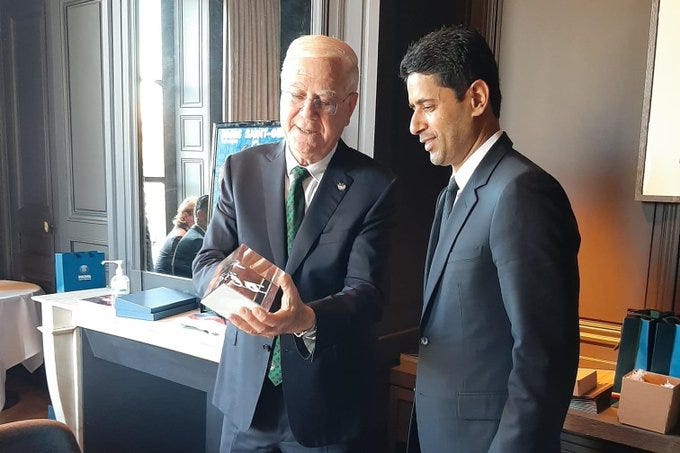
When PSG played Maccabi Haifa in 2022, Al-Khelaïfi hosted his counterpart Yaakov Shahar in Paris. Al-Khelaïfi lodged no protests to the French Super Cup final being played in Tel Aviv in 2021 and 2022. There was no impassioned defence of Achraf Hakimi when he was harassed by Israeli fans on multiple occasions. The PSG board also accepted the fine levied by UEFA earlier this year for the Ultras’s show of support for Palestine during the ongoing genocide.
The next UEFA Executive Committee meeting is slated for December 3rd of this year. The timing could provide a low pressure situation for UEFA to take the decision to ban Israel. Maccabi Tel Aviv, in all likelihood, will not advance to the knockout stages of the Europa League. The Israeli national team will not finish ahead of Italy or Norway and will be eliminated from World Cup contention come December. The next competitive fixtures are not scheduled until September 2026- when the much derided Nations League kicks off.
If the EBU chooses to boot Israel from Eurovision before their meeting on December 4th, momentum will further swing in favor of those supporting Israel’s football ban.